
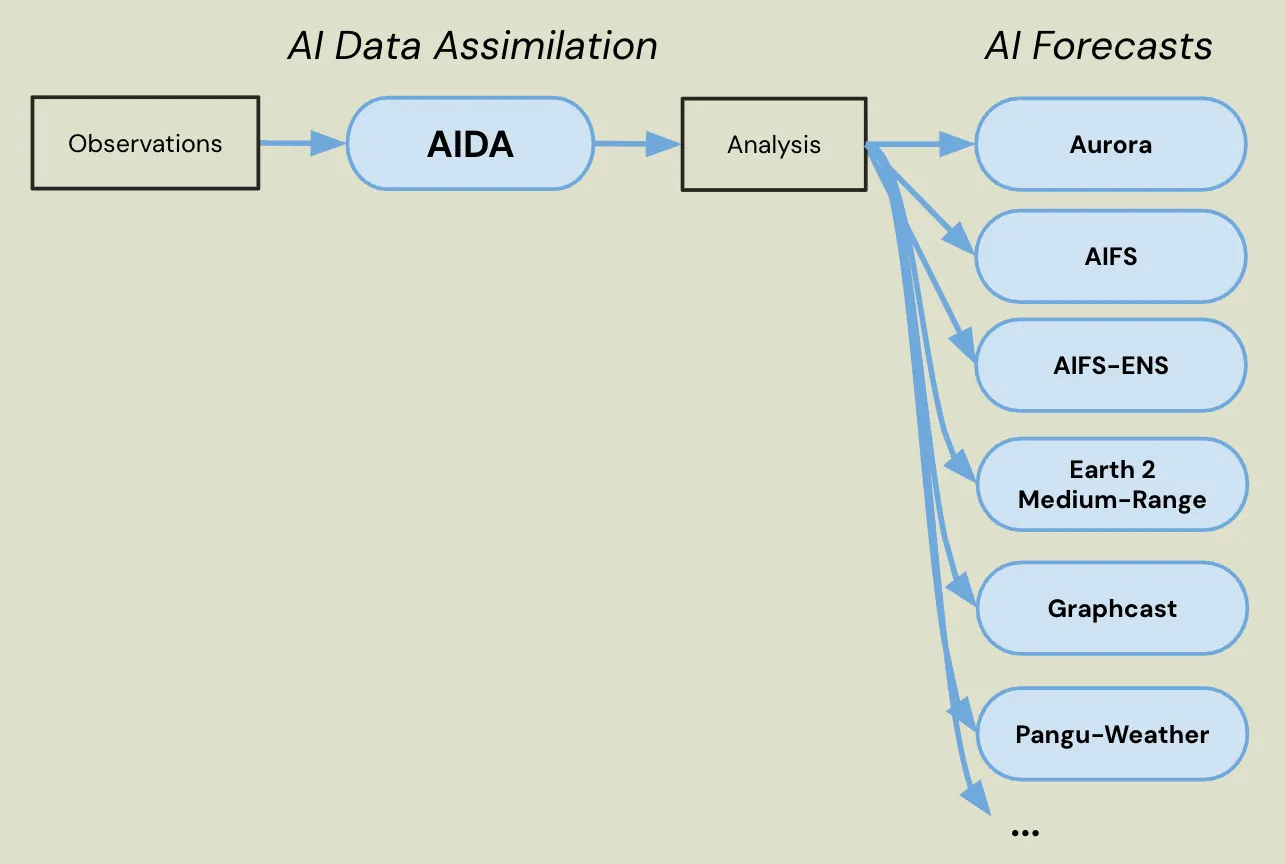
Brightband introduced its AI Data Assimilation model, AIDA, to AMS 2025. Over the past 12 months the AI weather community has made rapid progress, both in AI weather prediction from traditional analyses (Operational AIFS-ENS, Google’s FGN, NVIDIA Earth2 Medium-Range, etc.) and from observations (Aardvark, GraphDOP, Huracan, etc.).
At Brightband, we have been pushing forward our operational system that runs a range of AI weather prediction (AIWP) models initialized with our AIDA initial conditions, as well as traditional initial conditions from ECMWF and NOAA.
AIDA
Brightband’s AI Data Assimilation system, AIDA, maps directly from Level 1 sensor data (effectively raw data) to the current state of the weather. This avoids the dependence that most AI Weather forecasting models have on waiting for traditional Numerical Weather Prediction (NWP) Data Assimilation to provide the initial state of the weather. This means that we can flexibly add new sources of observational data, and it means that we get the forecast faster.
Observation Valuation
With Brightband’s end-to-end AI system, both data assimilation and forecast rollout are orders of magnitude faster than traditional NWP. This makes it feasible to run observation denial experiments at much finer granularity—down to individual instruments, specific geographic regions, or even individual observation locations. As a result, the computational barrier that limited Observing System Experiments (OSEs) in traditional NWP largely disappears. These analyses allow us to quantify the marginal value of existing observations, prioritize data sources that most improve forecast skill, and design optimal strategies for adding new observations to close gaps in the global sensor network.
The Model Zoo
There is an expanding “model zoo” of AI Weather Prediction (AIWP) models from different research groups, all slightly different. We love operationalizing AI Weather models so that you don’t have to. We currently run Aurora, GraphCast, Pangu-Weather, NVIDIA Earth2 Medium-Range, AIFS-Single, and AIFS-ENS, and we will continue to add models as they become available. We have also released a public archive of historical AI forecasts on the Earthmover Data Marketplace.
Next-Generation AIDA
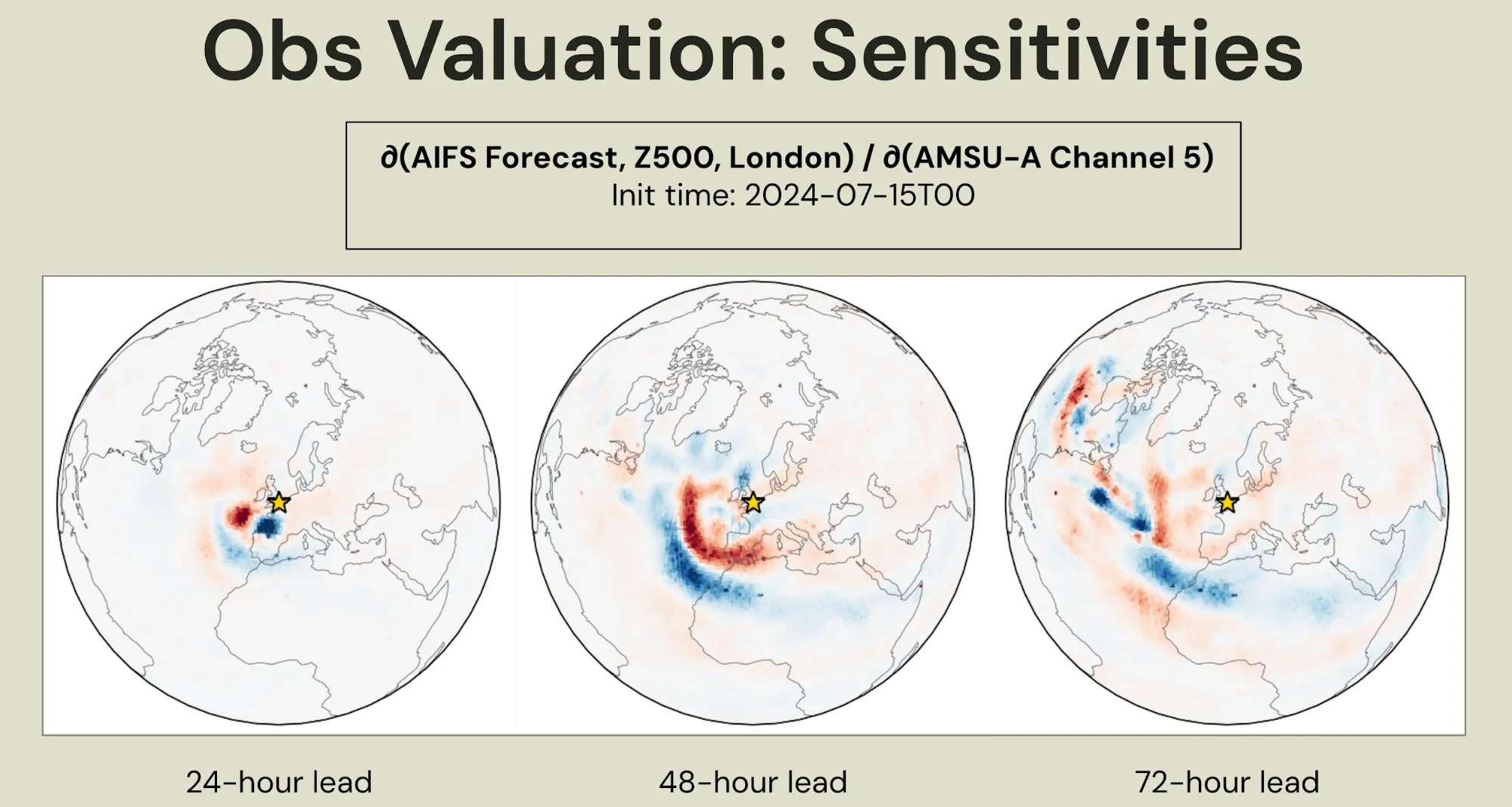
We are actively developing a next-generation AIDA system that assimilates all available observations within the data assimilation window, from a growing set of sensors and sensor types. The DA and forecasting steps are differentiably coupled so that we can optimize them as a single, end-to-end system to improve forecast skill. This end-to-end differentiability also allows us to run sensitivity analyses – quantifying how forecast outputs depend on specific observational inputs – for observation valuation. The figure below illustrates how AMSU-A observations influence forecasts of geopotential height over London at 24, 48, and 72-hour lead times.
By continually assimilating the world’s weather observations, Brightband’s next-generation AIDA will enable more skillful forecasts through a system built to adapt across applications, locations, and observation valuation use cases.